Sales reps spend 70% of their time on non-selling tasks, according to the 2024 State of Sales survey that Salesforce ran with 5,500 sales professionals. That figure explains why almost every CRM vendor now ships an AI layer and calls it a selling point.
Choosing the best AI CRM takes more care than the vendor pages suggest, since a survey reported by DestinationCRM ahead of 2026 found that only 38% of respondents had enabled AI features in their CRM and just 17% used more than two. Many teams pay for AI they never switch on.
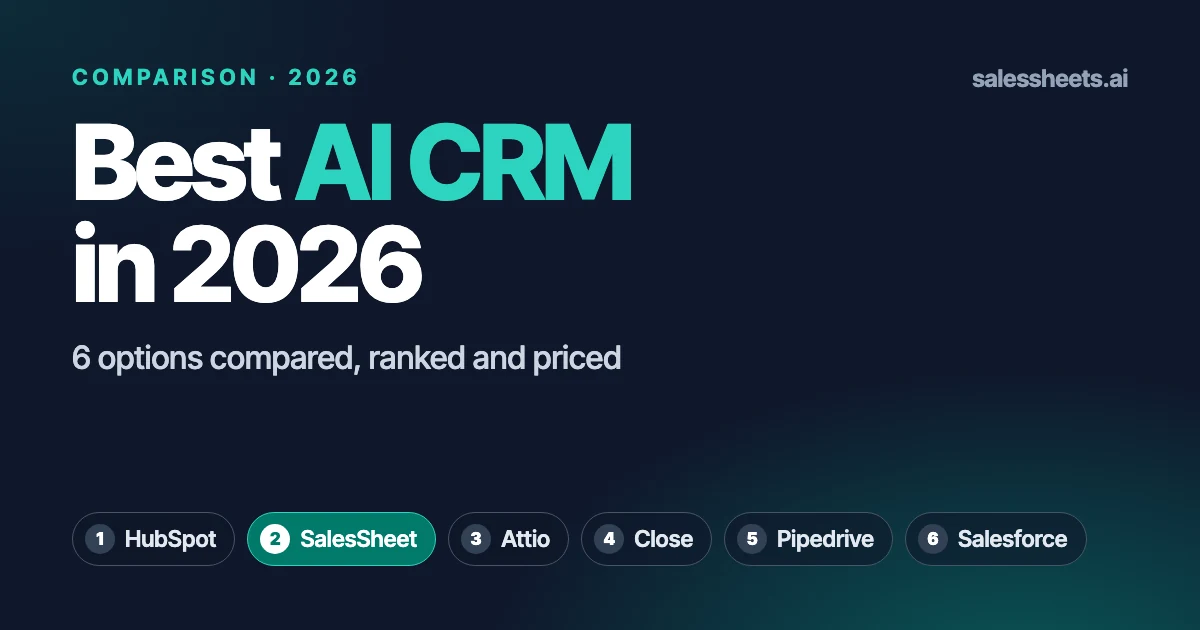
Below you will find six AI CRMs ranked on what their AI does, what a seat costs once AI is on and which team each one suits, with prices checked on October 19, 2026. We publish SalesSheet, which sits at number 2, and its entry explains exactly where it wins and where it does not.
Table of contents
An AI CRM is a customer relationship management system whose AI reads your pipeline and acts on it, by drafting emails, enriching contacts, summarizing calls and answering questions about your deals, instead of only storing records for a person to update.
The practical test is whether the AI saves a rep a task they would otherwise do by hand, such as logging a call or researching a prospect. A chat box that can only search your data passes that test less often than an assistant that can create the contact, draft the follow-up and update the deal stage in one command.
The gap between the first and last rows is the opportunity: AI adoption is nearly universal, while use of AI inside the CRM stays low. SalesSheet's own AI CRM page shows what an assistant looks like when it is the main interface and not an add-on.
Four criteria set the order, and each one comes from a cost or a failure that sales teams report after buying a CRM.
Price transparency carries the most weight, because the cost of AI is where listed and real prices drift apart: HubSpot adds a $1,500 onboarding fee at Professional and Salesforce sells Agentforce for Sales as an add-on, so the seat price alone understates what a team pays.
We could not test the competitors' products ourselves, so every competitor price below comes from the vendor's public pricing page, read on October 19, 2026. Where a page showed two prices without saying which billing period each one covers, we report both.
The order reflects how many kinds of team each tool serves well, with the best fit for each stated in its own entry so you can skip to your profile.
HubSpot is the broadest platform on this list, because its CRM sits next to marketing, sales and service tools and a lead can move from a campaign to a closed deal without leaving the system. Its AI runs on HubSpot Credits, which power agents such as the Customer Agent, the Prospecting Agent and the Data Agent.
On its Sales Hub pricing page (October 19, 2026) HubSpot lists a Free plan for up to 2 users, Starter at $7 or $20 per seat per month depending on billing, Professional at $90 or $100, and Enterprise at $150. Professional and Enterprise carry one-time onboarding fees of $1,500 and $3,500, and the paid plans include 500, 3,000 and 5,000 credits a month, with extra credits at $0.010 each.
HubSpot fits teams that run marketing and sales from one database and have someone to configure it. A team of three reps that only needs a pipeline with AI help ends up paying for platform breadth it will not use, and the $1,500 Professional onboarding fee arrives before the first deal is logged.
SalesSheet ranks second for one specific buyer: a team that sells over WhatsApp and wants AI agents to answer customers next to human reps. We publish SalesSheet, so read this placement as our opinion and test it against the criteria above. HubSpot ranks first because its marketing, sales and service tools cover more ground.
The product works as a shared workspace where reps and AI employees use the same inbox, pipeline and customer history. WhatsApp is built in, a browser dialer records and transcribes calls (see the calling page), and an AI copilot takes requests in plain language, as outlined on the AI CRM page.
SalesSheet prices per workspace, not per seat, and every plan includes unlimited users (SalesSheet pricing page, October 19, 2026). Starter costs $59 a month billed annually, or $71 month to month, and includes 1 AI employee, 250 conversations, 120 dialer minutes, 2 WhatsApp numbers and 10,000 contacts.
Pro costs $149 a month billed annually ($179 month to month) with 3 AI employees, 750 conversations, 400 dialer minutes, 6 WhatsApp numbers and 100,000 contacts, and Ultra costs $399 ($479 month to month) with 10 AI employees and 1,000,000 contacts. Every plan has a free trial, and no card is needed to start.
Limits are set in conversations, voice minutes and WhatsApp numbers instead of seats, so a team with heavy message volume can outgrow Starter faster than its headcount suggests. Starter also has no campaigns or social channels, and its marketing tools are narrower than HubSpot's, which matters if campaigns are a big part of your work.
Attio gives the most freedom over how data is modeled, because teams define their own objects and relationships instead of adapting to a fixed contact, company and deal template. Its assistant, Ask Attio, is listed on every plan, with usage metered through credits.
The Attio pricing page (October 19, 2026) shows Free for up to 3 seats, Plus at $35 per user per month billed annually ($44 monthly) for up to 10 seats, Pro at $79 ($99 monthly) with unlimited seats, and custom Enterprise pricing.
100 to 2,500
AI seat credits per user each month, from the Free plan to Enterprise (500 on Plus, 1,000 on Pro). Attio pricing page, October 2026
Attio suits startups with an unusual sales motion and someone willing to design the workspace. It is a weaker fit for a team that wants a ready-made sales process on day one, because the data model has to be built before it pays off, and heavy Ask Attio use is capped by the seat credits in the plan.
Close targets inside sales teams that live on calls, texts and email, and every plan includes its AI assistant, Chloe, along with worldwide calling, SMS and automatic call logging.
The Close pricing page (October 19, 2026) lists four plans, Solo, Essentials, Growth and Scale, at prices between $9 and $149 per user per month depending on tier and billing period, with 500, 1,000, 1,500 and 2,000 AI credits per user each month. A 14-day free trial needs no credit card and includes $5 of calling and enrichment credits.
Close fits teams that measure their week in calls made. The cost climbs with the dialer features, since the power dialer and voicemail drop start on the Growth plan at $99 to $109, while the predictive dialer and live call coaching are limited to Scale, so a team that needs them pays for the top tier.
Pipedrive is built around a visual deal pipeline, and it offers a marketplace of integrations. Its pricing page is the place to confirm what each tier includes before you shortlist it.
Pipedrive sells per-seat plans in several tiers, so the useful exercise is to price the number of reps you have against the tier whose features you need, and to check which AI and calling features each tier contains.
Pipedrive fits teams whose priority is a simple pipeline and a wide set of integrations. A team that wants AI agents answering customers or a dialer built in should compare those features line by line before choosing it.
Salesforce is the enterprise standard, and its AI offering is Agentforce. The Sales pricing page (October 19, 2026) lists Starter Suite at $25 per user per month, Pro Suite at $100, Core at $195, Advanced at $395 and Max at $550, with the higher editions billed annually.
AI can be added from the Core edition upward, and Agentforce for Sales is listed as a separate add-on starting at $125 per user per month. Ten reps on Core with the add-on come to at least $3,200 a month (10 seats at $195 plus 10 add-ons at $125).
Salesforce fits large organizations with complex processes and administrators to run them. A small team can start on Starter Suite at $25, although the agentic AI that gives Salesforce its reputation begins two editions higher, so the entry price says little about the price of the AI.
The seat price is often the smallest number in the bill, because credits, onboarding fees and AI add-ons sit on top of it. A five-person team shows the spread, using only prices listed on the pages above:
Seat count can change the ranking, since plan caps force upgrades. Attio Plus is limited to 10 seats, so an eleventh user moves the workspace to Pro at $79 annual, which turns a $350 monthly bill for ten seats into $869 for eleven. SalesSheet charges per workspace, so the same eleven reps stay on one $59 Starter bill, although conversation and voice-minute limits can push a busy team to Pro at $149.
Those figures cover seats and the AI each plan includes, so heavy users should also price the extra credits. HubSpot sells them at $0.010 each, and Salesforce sells Agentforce for Sales separately.
The table keeps only the details that change a purchase decision: who each tool is for, what the first paid seat costs and how its AI is packaged.
| Tool | Best for | Entry paid price (per seat per month unless noted) | How the AI is packaged |
|---|---|---|---|
| HubSpot | Marketing and sales on one platform | $7 to $20 (Starter); $90 to $100 (Professional) plus $1,500 onboarding | Credit-based agents; 500, 3,000 or 5,000 credits a month by plan |
| SalesSheet | Teams selling over WhatsApp with AI agents | $59 per workspace (Starter, annual); $149 (Pro); unlimited users | AI employees and a copilot; 1, 3 or 10 AI employees by plan |
| Attio | Teams that need a custom data model | $35 (Plus, annual); $79 (Pro, annual) | Ask Attio on every plan; 100 to 2,500 seat credits |
| Close | Call-heavy inside sales | $9 to $19 (Solo); $99 to $109 (Growth) | Chloe on every plan; 500 to 2,000 credits |
| Pipedrive | Simple visual pipeline | Per-seat plans in tiers, see its pricing page | Varies by tier, see its pricing page |
| Salesforce | Large organizations | $25 (Starter Suite); $100 (Pro Suite) | AI from Core ($195); Agentforce for Sales add-on from $125 |
Source: vendor pricing pages, checked October 19, 2026
Two patterns stand out in the table. Only HubSpot and Salesforce attach a separate charge to setup or to the AI itself, through an onboarding fee from $1,500 and an add-on from $125, while Attio, Close and SalesSheet publish their AI allowances next to the price.
The right answer follows from team size, from who will maintain the system and from how much of the sales day happens on the phone.
For most teams under ten reps that do not need a full marketing suite, a reasonable shortlist is SalesSheet, Attio and Close, with HubSpot joining the list the day marketing needs to share the database. Larger or more regulated organizations tend to start from Salesforce and work backwards. Teams of two to ten reps can also read more about CRMs for small sales teams.
Run the shortlist against 20 of your own open deals for two weeks, since the way an assistant handles your real contacts tells you more than any feature list.
Free entry points make this cheap: HubSpot has a Free plan for up to 2 users, Attio has Free for up to 3 seats, Close offers a 14-day trial with no card and SalesSheet offers a free trial. Count the minutes each tool saves on logging, follow-ups and call notes, then compare the totals with the price table above.
Track three numbers during the test: the minutes saved per rep per day on logging and follow-ups, the number of conversations the AI handles without a rep, and how many AI features each rep uses in a normal week. The last number is the one the 38% and 17% figures above warn about.
See how AI employees, WhatsApp and a built-in dialer work in one workspace.
Start Free TrialHubSpot is the best AI CRM for teams that need marketing and sales on one platform, SalesSheet for teams that sell over WhatsApp and want AI employees answering next to their reps, and Attio for teams that need a custom data model. The right pick depends on team size and on how much of your work happens by phone.
Listed prices on October 19, 2026 start at $59 per workspace per month for SalesSheet Starter, with unlimited users, and run from $35 per seat for Attio Plus (annual) to $100 per seat for Salesforce Pro Suite. HubSpot Professional adds a $1,500 one-time onboarding fee, and credits or add-ons for heavier AI use are extra on several of these.
Several offer a free entry point. HubSpot has a Free plan for up to 2 users, Attio has a Free plan for up to 3 seats with Ask Attio included, Close has a 14-day trial with no credit card, and SalesSheet offers a free trial with no card needed. Free tiers cap seats or AI credits, so check the limits.
Often, yes, at least beyond a monthly allowance. HubSpot meters agents with credits at $0.010 each, Attio and Close allot AI credits per seat, and Salesforce sells Agentforce for Sales as an add-on from $125 per user per month. SalesSheet sets its AI limits per workspace, through conversations, voice minutes and copilot credits.